Showing posts with label carnivore. Show all posts

Friday, December 12, 2014

Dinosaurs 101


How do you know what the enemies of a dinosaur were?

Answer: The actual predators of most dinosaurs are not known. To determine what dinosaurs a meat-eater ate is very difficult since the fossil record is all there is, and it is very incomplete.

Fossil evidence
There are only a few ways of finding out about dinosaur predator/prey relationship, and they are all very rare.

  • Fossilized stomach contents can tell you exactly what that dinosaur ate for its last meal (but only its last meal, not necessarily its entire diet). For example, Baryonyx stomach contents were found to contain fish scales.
  • Fossilized dung also lets you know the contents of a dinosaur's meal. Unfortunately, figuring out what dinosaur the fossilized dung came from is not easy. Recently, T. Rex dung was found containing crushed Triceratops bone. Fossilized dung is called coprolites.
  • Finding two fossilized dinosaurs that died in battle lets you know about the predator/prey relationship. In Mongolia, a Velociraptor and Protoceratops were found together, each bearing battle wounds (like teeth marks in the bones). 

Friday, November 21, 2014

Dinosuars 101

Were more dinosaurs carnivores or herbivores?

There were many more plant-eaters! 

Some dinosaurs were carnivores (meat-eaters) but most were herbivores (plant-eaters). In any food chain, there have to be more organisms at the lower levels of the chain because the transfer of food energy is inefficient and much of the energy is wasted. During the Mesozoic Era (as in other times), plant diversity was greater than animal diversity. 


Thursday, September 19, 2013

Dinosaurs 101

Quiz question
Were the largest dinosaurs carnivores (meat-eaters)
or herbivores (plant-eaters)? 

 They were herbivores

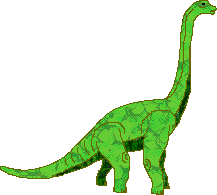
The biggest dinosaurs were sauropods; they were gigantic, slow moving, tiny-headed, cow-like plant-eaters from the late Jurassic and the Cretaceous period. They had very long necks which were useful for reaching wide (and tall) swatches of vegetation. The lengthy neck was counterbalanced by a massive tail. These sauropods are the largest land animals ever discovered:
    Brachiosaurus
  • Supersaurus - 134 feet long (41 m)
  • Argentinosaurus - 115-130 feet long (35-40 m); 80-100 metric tons
  • Seismosaurus ("Earth-shaking lizard") - 120+ feet long (37 m); +80 tons
  • Ultrasauros - 100 feet long (30 m), +80 tons
  • Diplodocus - grew up to 90 feet long (28 m).
  • Brachiosaurus - about 85 feet long (26 m), 40 feet tall, and weighed 70-80 tons. 


The biggest carnivores were much smaller. They were theropods from the Cretaceous period and include:

  • Giganotosaurus carolinii - 47 feet long (14 m), 8 tons in weight, and 12 feet tall (4 m).
  • Tyrannosaurus rex - 40-50 feet long (12-15 m), 6 tons in weight.
  • Carcharodontosaurus saharicus - probably about 45 feet long.

Thursday, April 18, 2013

Dinosaurs 101


Meet Mrs. Pteranodon

Meaning - Pteranodon means "Winged and Toothless"
Pronounced - ter-AN-o-DON

Mrs. Pteranodon: teacher, companion, and tour guide extraordinaire. But, first and foremost, she is "Mom" to Buddy, Don, Tiny, and Shiny. She is always there to listen to Buddy's questions about being an adopted member of the Pteranodon family. Mrs. Pteranodon is intent on a good education, but she is also always looking for ways to let her kids explore their world.

Mrs Pteranodon was a carnivore but probably ate mostly fish. Her wingspan exceeded that of the American Bald Eagle by about 20 feet as her wingspan would be about 25- 35 feet across! It's kinda hard to say how tall she was but some scientists say she may have been 6 feet tall at the hips. Seems like that would make her about 12- 15 feet tall....

Pteranondon lived during the late Cretaceous Period , about 85-75 million years ago. There have been fossils found in the USA in Kansas making this family an American family!