Showing posts with label herbivore. Show all posts

Friday, December 12, 2014

Dinosaurs 101


How do you know what the enemies of a dinosaur were?

Answer: The actual predators of most dinosaurs are not known. To determine what dinosaurs a meat-eater ate is very difficult since the fossil record is all there is, and it is very incomplete.

Fossil evidence
There are only a few ways of finding out about dinosaur predator/prey relationship, and they are all very rare.

  • Fossilized stomach contents can tell you exactly what that dinosaur ate for its last meal (but only its last meal, not necessarily its entire diet). For example, Baryonyx stomach contents were found to contain fish scales.
  • Fossilized dung also lets you know the contents of a dinosaur's meal. Unfortunately, figuring out what dinosaur the fossilized dung came from is not easy. Recently, T. Rex dung was found containing crushed Triceratops bone. Fossilized dung is called coprolites.
  • Finding two fossilized dinosaurs that died in battle lets you know about the predator/prey relationship. In Mongolia, a Velociraptor and Protoceratops were found together, each bearing battle wounds (like teeth marks in the bones). 

Friday, November 21, 2014

Dinosuars 101

Were more dinosaurs carnivores or herbivores?

There were many more plant-eaters! 

Some dinosaurs were carnivores (meat-eaters) but most were herbivores (plant-eaters). In any food chain, there have to be more organisms at the lower levels of the chain because the transfer of food energy is inefficient and much of the energy is wasted. During the Mesozoic Era (as in other times), plant diversity was greater than animal diversity. 


Thursday, September 19, 2013

Dinosaurs 101

Quiz question
Were the largest dinosaurs carnivores (meat-eaters)
or herbivores (plant-eaters)? 

 They were herbivores

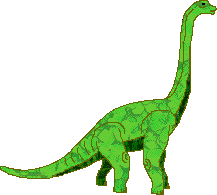
The biggest dinosaurs were sauropods; they were gigantic, slow moving, tiny-headed, cow-like plant-eaters from the late Jurassic and the Cretaceous period. They had very long necks which were useful for reaching wide (and tall) swatches of vegetation. The lengthy neck was counterbalanced by a massive tail. These sauropods are the largest land animals ever discovered:
    Brachiosaurus
  • Supersaurus - 134 feet long (41 m)
  • Argentinosaurus - 115-130 feet long (35-40 m); 80-100 metric tons
  • Seismosaurus ("Earth-shaking lizard") - 120+ feet long (37 m); +80 tons
  • Ultrasauros - 100 feet long (30 m), +80 tons
  • Diplodocus - grew up to 90 feet long (28 m).
  • Brachiosaurus - about 85 feet long (26 m), 40 feet tall, and weighed 70-80 tons. 


The biggest carnivores were much smaller. They were theropods from the Cretaceous period and include:

  • Giganotosaurus carolinii - 47 feet long (14 m), 8 tons in weight, and 12 feet tall (4 m).
  • Tyrannosaurus rex - 40-50 feet long (12-15 m), 6 tons in weight.
  • Carcharodontosaurus saharicus - probably about 45 feet long.

Thursday, July 4, 2013

Dinosaurs 101


 Seismosaurus
 size-muh-SAWR-us

Seismosaurus was an enormous, long-necked, whip-tailed, small-headed dinosaur. It measured about 130-170 feet long and was roughly 18 feet tall (measured from the ground to the top of the shoulder). may have weighed about  60,000 pounds. It was among the longest land animals that ever lived.
Seismosaurus' nostrils were at the top of its tiny head. Its small mouth had peg-like teeth, but only in the front of the jaws. Its front legs were shorter than its back legs, and all had elephant-like, five-toed feet. Its short legs may have helped stabilize this enormous dinosaur. One toe on each foot had a thumb claw, probably for protection. Its backbone had extra bones underneath it, which had bony protrusions running both forwards and backwards (chevron shaped), probably for support and extra mobility of its neck and tail.
Seismosaurus was an herbivore (it ate only plants).
Seismosaurus was a sauropod, whose intelligence was the among the lowest of the dinosaurs. 
True or False? Seismosaurus was an ancient ancestor of the seismograph?
That is False because a seismograph is an instrument used for measuring the motion of the ground!

Thursday, February 14, 2013

 
Meet Stacie Styracosaurus! She's quite happy to be at the Hornicopia celebrating the growth of her first horn!

Styracosaurus   sti-rake-oh-soar-us
meaning "spiked lizard" was a herbivore (veggie head) ceratopsian from the late Cretaceous Peiod.

cer·a·top·si·an: [ser-uh-top-see-uhn]

Paleontologists broadly define ceratopsian as herbivorous, four-legged, elephant-like dinosaurs whose enormous heads sported elaborate horns and frills.  Ceratopsian may be the most "All-American" of all the dinosaurs, though some species did hail from Eurasia.


Our friend Stacie has just matured to the age where her first horn can be seen, this horn on her nose could grow to be about 2 feet long. As she  continues to grow and mature, her neck frills will also be adorned with  4 to 6 horns. As an adult Stacie Styracosaurus could weigh as much as 6000 pounds (that's 3 tons) , be about 6 feet tall, and about 30 feet long! Whoa! A distant cousin of Stacie's could be anyone in the Triceratops family or in the Protoceratops family too.

Styracosaurus' lived in the late cretaceous period about 76 - 70 million years ago. she also walked on all fours, so we can call her a quadraped. Amazing how she grows so big and strong from a diet of leaves and greens. How big could you grow if all ou ate were your veggies?

Do you think she has a Valentine? Afterall, she is a very pretty shade of pink....